Dotun Opasina

  • About
  • AI Strategy
  • Agentic AI Use Cases
  • Trainings

Is Your AI Roadmap a Bridge to the Future — or to a Dead End?

June 23, 2026 by Oladotun Opasina

Every AI strategy deck I've reviewed in the last six months has the same shape. Cut 10% of support tickets with an agent. Roll out Copilot to engineering. Stand up an AI-powered intake form. Build an internal knowledge agent for sales. Each initiative returns a believable, defensible, board-approvable number. Each one passes the prudence test.

Taken together, they add up to a strategy quietly making a much bigger bet than the leadership team has acknowledged: that the business they're running today will still be the relevant business in 2029.

That's the bet. It's not on the deck. Nobody voted on it. But it's the bet underneath every marginal AI play, because every marginal play assumes the business model is stable enough to be worth optimizing. In this environment, that's not a safe assumption — it's the riskiest one in the room.

The marginal-play trap

What looks like prudent strategy in 2026 is usually a category error. Marginal plays work when the environment is stable and you're optimizing a known model. They produce real returns and they survive the board cycle. What they don't do is change what the company is. They don't update the business model. They don't reposition the workforce. They don't reimagine the product. They take the existing organization, slightly more efficient, into a future where the question isn't "are we efficient?" but "are we relevant?"

I'm watching this play out in real time. The skeptical client running every AI initiative through a 12-month ROI gate. The leadership team that approved a $40M AI program where the boldest item is "augment customer service." The board praising the CIO for prudent AI governance while the underlying business is being structurally rebuilt by competitors three time zones away. None of these leaders are stupid — they're running a playbook that worked in every previous technology cycle, and finding out the hard way that this cycle is shaped differently.

What bold actually looks like

Bold isn't a mood. It's a posture toward variance. The leaders making the strongest AI plays aren't being reckless — they're making the correct read on the environment. When the capability frontier moves this fast, the highest expected-value move isn't the lowest-variance one. Accepting more variance now is buying optionality later.

Three examples from earlier posts in this series. Mizuho didn't add AI to its existing workflow — it built a "Process Design Group" as the organizational frame for what work would look like after AI absorption, funded like infrastructure not a project. JPMorgan didn't pilot AI; it committed $135 billion in capex with a stock plan tied to a market cap target that requires the substitution play to work at scale. Salesforce didn't bolt AI onto the existing org — it stood up Career Connect and pushed its Forward-Deployed Engineer team past 1,000, structurally rebuilding what kind of company it is.

These aren't moonshots — they're deliberate, instrumented bets. They share a property the marginal plays don't: they presume the business will look different in three years, and they're investing in being that different business rather than optimizing the current one. Not a hundred small pilots. A handful of foundational moves organized around a concrete picture of what the organization becomes.

The one-page exercise

If you read no other strategic recommendation from me this year, do this one. Take an hour with the leadership team and write a one-page description of what your company looks like in 2029 if AI continues developing at its current pace. Not the company you're managing now plus AI features. The company you would build today if AI were the default assumption — workforce, product, customer relationship, business model, all of it.

Then take every AI initiative on your roadmap and ask: is this a bridge to that future, or a bridge to a dead end?

Most leadership teams I've run this with discover the same uncomfortable thing. Two-thirds of their AI initiatives are optimizing the company they're trying to evolve away from. Marginal plays aren't neutral — they're consuming the resources, attention, and political capital the bold moves require.

The honest close

The riskiest move in 2026 isn't betting boldly. It's betting incrementally on the assumption that your current business will still be the one that matters in 2029. Marginal plays are a fine hedge when the environment is stable. When the environment is the variable, hedge-shaped strategies underperform vision-shaped ones, and the gap compounds.

Spend the hour. Write the page. The leaders who'll look prescient in 2029 are doing this work right now, while the rest of the industry optimizes the company that won't exist anymore.

References & related posts:

Salesforce, "How Salesforce Is Reshaping Its Workforce in the Age of AI," April 2026. https://www.salesforce.com/news/stories/salesforce-reshaping-workforce-in-age-of-ai/

Nick Lichtenberg, "Jamie Dimon and Dario Amodei shared a stage for the first time. Here's what they revealed about AI, cyber risk and the future of Wall Street," Fortune, May 5, 2026. https://fortune.com/2026/05/05/anthropic-wall-street-financial-services-agents-jamie-dimon/

The Next Web, "Meta cuts 8,000 jobs and cancels 6,000 open roles as $135B AI spending reshapes the company from the inside," April 24, 2026.

June 23, 2026 /Oladotun Opasina
Comment

The Gap Between Your AI Demo and Production Is Bigger Than You're Budgeting For

June 09, 2026 by Oladotun Opasina

In January, Air Canada's autonomous booking agent rebooked 1,247 passengers onto incorrect flights during a Toronto weather disruption. The agent worked fine in testing. It worked fine on a normal Tuesday. It fell apart the first time it encountered the kind of operational chaos every airline encounters several times a year.

That failure isn't an outlier. It's a deployment pattern. Step Finance watched its AI trading agents autonomously move $27–30 million off compromised executive devices because the agents had blanket SOL transfer authority and no value-threshold checks. Between December 2025 and February 2026, a single attacker used Claude Code and GPT-4.1 to breach nine Mexican government agencies and exfiltrate 195 million taxpayer records. In all three, the agents were doing exactly what their permissions allowed. The mistake was upstream.

Most C-suite leaders are budgeting demo-to-production as the last 20% of the work. It's the next 60%. Cloud Security Alliance research found 65% of organizations have already had an AI agent–related incident. Gartner predicts that by 2027, 40% of enterprises will demote or decommission autonomous agents over governance gaps surfaced only after production incidents.

Here's what the in-between actually contains.

The work you do once

Foundational pieces that have to exist before an agent is allowed in production — hard, real engineering, built once. These map directly to the OWASP Top 10 for Agentic Applications (December 2025) and NIST's AI Agent Standards Initiative (February 2026):

  • Narrow scoping of permissions. Least-privilege access — what data the agent can read, write, or never touch. Step Finance's agents had blanket transfer authority. That's the agentic equivalent of plaintext root access.

  • The data and identity boundary. Which systems the agent can authenticate into, with what credentials, and how those credentials are scoped. The Mexican government breach didn't happen because the AI was wrong; it happened because the AI had access to credentials nobody had bounded.

  • Human-in-the-loop checkpoints. Which actions require human confirmation, which don't, and how that decision was made — documented and reviewable. Especially for actions above a value or impact threshold.

  • Observability infrastructure. Logging every prompt, decision, tool call, and outcome so failures are diagnosable after the fact. If you can't reconstruct what the agent did and why, you can't fix it.

  • Kill switches. How fast can you turn this off, and who has authority. If the answer is "we'd have to file a ticket," you're not ready for production.

Table stakes. An agent that lacks any of these shouldn't be in production.

The work that never ends

Pieces most leaders never budget for, because they don't look like projects. They're permanent functions:

  • Permissions narrowing. As you learn what the agent actually does in production, you should be tightening scope, not loosening it. Most teams loosen because tightening creates friction. That's how Step Finance happens.

  • Edge case discovery. Production reveals failure modes nobody designed against. Air Canada's weather disruption was one. Each new one has to be cataloged, tested against, and fed back into the agent's behavior. Permanent loop.

  • Trust-tier graduation. Agents earn additional scope by demonstrating reliability — and lose it when they fail. A ratchet, not a binary switch. Most enterprises don't have a graduation framework at all; they have a launch date.

  • Drift monitoring. The model changes. The data distribution changes. User behavior changes. Performance silently degrades unless someone is watching — what IEEE Spectrum recently called the "quiet failure" problem. The agent that worked in February isn't the agent you have in August.

  • Incident retro discipline. Every production incident is data. The question is whether your organization has the muscle to turn it into the next iteration — or whether incidents get filed, blamed, and forgotten.

What this changes for C-suite sponsorship

Three things to do this quarter if you're sponsoring an agentic AI program:

  1. Budget the in-between explicitly. Demo-to-production for a non-trivial agent is six to eighteen months, not weeks. If your roadmap shows the latter, you're funding a future incident.

  2. Measure on trust graduation, not launch dates. Ship dates reward velocity, which is what produces the Step Finance pattern. Trust graduation rewards agents that have earned their scope.

  3. Build the iterative muscle as a permanent function. Incident retros, narrowing reviews, drift monitoring — these need owners with continuity, not a project team that disbands after launch.

The gap between demo and production is where trust in agentic AI is built — or where the next headline gets written. The companies that price the in-between honestly are the ones whose agents are still running in eighteen months.

Sources & further reading:

OWASP GenAI Security Project, "OWASP Top 10 for Agentic Applications 2026," December 9, 2025. https://genai.owasp.org/resource/owasp-top-10-for-agentic-applications-for-2026/

NIST, "AI Risk Management Framework" and "AI Agent Standards Initiative" (CAISI), February 2026. https://www.nist.gov/itl/ai-risk-management-framework

Cloud Security Alliance & Token Security, Autonomous but Not Controlled: AI Agent Incidents Now Common in Enterprises, April 21, 2026.

Cloud Security Alliance Labs, "Agentic NIST AI RMF Profile," April 2026. https://labs.cloudsecurityalliance.org/agentic/agentic-nist-ai-rmf-profile-v1/

Gartner, "Gartner Says Applying Uniform Governance Across AI Agents Will Lead to Enterprise AI Agent Failure," May 26, 2026. https://www.gartner.com/en/newsroom/press-releases/2026-05-26-gartner-says-applying-uniform-governance-across-ai-agents-will-lead-to-enterprise-ai-agent-failure

IEEE Spectrum, "How Quiet Failures Are Redefining AI Reliability," April 22, 2026. https://spectrum.ieee.org/ai-reliability

ISO/IEC TS 22440, "Artificial Intelligence — Functional Safety and AI Systems," 2025.

June 09, 2026 /Oladotun Opasina
Comment

Agentic AI Doesn't Save Money. It Makes You New Revenue.

June 02, 2026 by Oladotun Opasina

For twenty years, "monetizing your data" has meant three things: sell access, build analytics on it, or use it to improve your product. Variations on selling a view.

That's over. In 2026, a fourth option emerged that's quietly more valuable than the first three combined: turn your proprietary data into an agentic product customers pay per use — not per seat, not per month, but per action completed. The companies finding this model first aren't AI startups. They're incumbents whose data was already sitting in their warehouses.

The new product shape

Intercom's Fin charges $0.99 per support resolution — with a $1 million performance guarantee if it doesn't hit 65% autonomous resolution. Fin handles over a million conversations a week. The product is a support inbox turned into a per-resolution outcome. Intercom didn't pivot to AI; it took conversational data it had been sitting on for a decade and wrapped a model around it. The data was the moat.

Sierra, Bret Taylor's company, sells outcome-priced customer service agents into healthcare and financial services — patient authentication, mortgage applications, claims handling. You pay when the agent completes the task. The pitch isn't "we built better AI." It's "we built agents that work inside your data, your compliance posture, your regulatory perimeter."

Mastercard with DBS and UOB completed the first live authenticated agentic payment transaction in Singapore on March 4, 2026 — an AI agent booked a ride to Changi Airport on Mastercard's Agent Pay platform, with payment authorized through tokenized credentials and Payment Passkeys. The product isn't the agent. It's agentic payment authorization itself — a category that didn't exist eighteen months ago. Mastercard's network rails + the banks' customer trust graphs made it possible.

Citi Wealth's Citi Sky, unveiled at Google Cloud Next 2026, turns Citi's proprietary research and client portfolio data into a real-time conversational AI agent for Citigold clients — built on Google's Gemini Enterprise Agent Platform and DeepMind avatar tech. Andy Sieg, Citi's Head of Wealth: "This is the shift from interface to intelligence, from transactions to outcomes." The data was Citi's. The runtime was Google's. The product is new.

What this changes about strategy

For decades, the only way to monetize proprietary data was to embed it in a workflow product and charge by the seat. Agentic AI breaks that bundle. The data doesn't need a workflow product anymore — it needs an agent that uses it to complete a task someone will pay for. Per-task pricing lets you address customers who'd never buy your seat product because they don't need the workflow; they just need the outcome.

Your dataset inventory is now a product inventory. Every dataset that supports a high-value, repeatable decision is a potential agentic product. Not "could we add AI to this dashboard" — but "could this data complete a task a customer would pay $5 to have done, 100,000 times a week." A dataset that supported one $50/seat product can support a $0.50-per-task product with 100x the market.

The competitive question is reversed. AI startups spent 2023–2025 racing to build models. The companies winning in 2026 spent the same years building proprietary data. Startups now need data partners; incumbents have the data and just need a model.

Outcome pricing is a moat, not a billing choice. Charging per resolution or per transaction makes your product directly comparable to the cost of the human doing the same thing. Brutal for vendors still selling seats. Defensible for incumbents willing to commit.

What to do this quarter

The question for your next product offsite isn't "what AI features should we add." It's "which of our datasets, wrapped in an agent and priced per task, becomes a product we couldn't sell before?"

Three filters to run your data inventory through:

  1. Decision repetition. Does this dataset support a decision someone makes hundreds or thousands of times a month? Per-task pricing only makes sense at volume.

  2. Outcome clarity. Can the result be measured cleanly — resolved, approved, completed, qualified? Agentic pricing requires unambiguous outcomes.

  3. Data exclusivity. Could a competitor with the same model but different data build it? If yes, the moat is weak.

If a dataset clears all three, you have a product hiding inside data you've been treating as overhead. Companies running this exercise in Q3 will be selling new product lines in Q1 2027.

The data has been a product all along. The agent is just the runtime that finally lets you sell it.

Sources:

Intercom, "Fin AI Customer Service Agent — Pricing Comparison," fin.ai/learn/ai-customer-service-agent-pricing-comparison

Mastercard Newsroom, "Mastercard delivers its first live agentic transaction in Singapore with DBS and UOB," March 4, 2026. https://www.mastercard.com/news/ap/en/newsroom/press-releases/en/2026/mastercard-delivers-its-first-live-agentic-transaction-in-singapore-with-dbs-and-uob/

Citigroup, "Citi Wealth Unveils 'Citi Sky' — An AI-Powered Member of the Citi Wealth Team, Built Using Google Cloud and Google DeepMind Technologies," April 22, 2026. https://www.citigroup.com/global/news/press-release/2026/citi-wealth-unveils-citi-sky-ai-powered-member-google-cloud-deepmind-technologies

June 02, 2026 /Oladotun Opasina
Comment

The Operating Layer Decision That Defines the Next Decade of Banking

May 26, 2026 by Oladotun Opasina

On May 5, Jamie Dimon and Dario Amodei shared a stage for the first time, and Anthropic used the moment to say the quiet part out loud: it doesn't want to sell software to banks. It wants to become the operating layer for Wall Street — the analytical substrate every bank's work runs on top of.

That's a bigger claim than it sounds, and most CIOs are treating it as a procurement question when it's a strategy question. The decision being made right now, across every major financial institution, will define competitive position for the next decade — and it's being made by default.

The 48-hour blitz

In two days, Anthropic launched roughly ten pre-built AI agents for the most labor-intensive workflows in finance — pitchbooks, earnings analysis, credit memos, underwriting, KYC, month-end close — on top of Claude Opus 4.7, which it says leads the industry's finance-agent benchmark. It rolled out full Microsoft 365 integration. It embedded Moody's platform into Claude, putting risk data on 600 million companies inside the interface. And one day earlier, it announced a $1.5 billion joint venture with Blackstone, Hellman & Friedman, and Goldman Sachs to put Claude at the core of how mid-sized companies run.

Claude is already in production at JPMorgan, Goldman, Citi, AIG, and Visa. This isn't a pilot. It's an occupation — infrastructure, deployment mechanism, and data partnerships assembling into a single substrate the banks plug into.

The sentence every CIO should sit with

The most revealing moment came from the closing panel. Goldman Sachs CIO Marco Argenti described what's shifting: "This is the first time that instead of buying infrastructure, you can actually buy intelligence."

He meant it as praise. It's also the entire strategic question, stated plainly. For thirty years, banks bought infrastructure and built the intelligence themselves. Argenti is describing the inversion: you now buy intelligence as a service, and the capability at the core of the business becomes something you rent from a frontier lab.

JPMorgan CIO Lori Beer named the real constraint: "There's this capability overhang. The technology can do so much. It's the actual organization's ability to digest and absorb it that tends to be where the gap is." She's right — but if the differentiator is purely absorption, the intelligence everyone's absorbing comes from the same handful of vendors.

What you're actually deciding

The decision facing every financial services CIO isn't "should we use AI." That's settled. It's how much of your core analytical capability you'll source from a vendor who also serves your competitors.

There are real advantages to renting: you skip the capital expense, get frontier capability immediately, and let someone else carry the infrastructure risk. None of that is naive. But renting your operating layer has a cost that doesn't show up in the first procurement cycle. When the agents come from the same vendor your competitor uses, on the same model, drawing on the same data partnerships, the analytical layer stops being a differentiator and becomes a utility. Your edge has to come from where the vendor doesn't reach — proprietary data, judgment, client relationships. The firms that win won't have the best AI. Everyone will have the same AI. They'll be the ones who knew which parts to keep in-house.

The question for your next strategy session isn't whether to adopt — that's table stakes. It's what you refuse to rent. What you outsource completely is what you can no longer compete on, and right now that line is being drawn by default — one pre-built agent at a time.

Source:

Nick Lichtenberg, "Jamie Dimon and Dario Amodei shared a stage for the first time. Here's what they revealed about AI, cyber risk and the future of Wall Street," Fortune, May 5, 2026. https://fortune.com/2026/05/05/anthropic-wall-street-financial-services-agents-jamie-dimon/

May 26, 2026 /Oladotun Opasina
Comment

Everyone's Sick of AI Content. The Data Backs Them Up.

May 19, 2026 by Oladotun Opasina

Let me get the awkward part out of the way: I used AI to help write parts of this post. Most people writing about AI right now did. The tension I'm about to describe — the gap between what producers want from AI and what consumers want from us — is one I'm sitting inside, not standing above.

A Gartner survey of 1,539 US consumers, released in March, found 50% prefer brands that don't use generative AI in consumer-facing messaging, advertising, and content. 68% frequently question whether content they see is real. 61% question whether information they use to make decisions is reliable. By end of 2025, only 27% used "intuition" to assess truth.

The assumption underneath the last 18 months of AI deployment is what this data invalidates: customers wouldn't notice, wouldn't care, wouldn't be able to tell. They notice. They care. They can tell.

The producer-consumer dilemma

Here's the part nobody's saying out loud.

  • For the people making content — marketers, writers, analysts, brands, founders, me — AI is a massive advantage. It compresses time, lowers cost, lets a one-person team produce what used to require five. First drafts, images, call summaries, emails. Used well, it makes good producers more productive.

  • For the people consuming that content — everyone, in the other half of our lives — AI is a degradation. Feeds full of generic copy. Images we have to second-guess. Reviews that mean less. Search results clogged with content that exists to rank. The producer surplus comes out of the consumer surplus, dollar for dollar.

Most of us are both. Same person, opposite incentives. The choices I make as a producer make the experience worse for me as a consumer — and for everyone else. Most strategy framing tries to resolve this by pretending the conflict doesn't exist. That's how we got the 50% figure.

So what actually works

The instinct on reading this data is to retreat — pull AI out and hope trust comes back. Wrong move. The producers winning aren't avoiding AI. They're using it in ways the consumer would still choose if they knew what was happening behind the scenes.

Three practices I'm trying to apply to my own writing:

  • Label it. Really label it. Not buried in a disclaimer. Not "AI-assisted" when AI wrote the whole thing. The trust-positive move is to be more transparent than required — tell people what AI did, what you did, where the line was.

  • Use AI for the parts that don't need you. Research summaries, formatting, transcript cleanup, first-pass drafts — places AI saves time without changing the substance.

  • Don't use AI for the parts that are the point. Your voice. Your argument. Your judgment about what to say. Every shortcut here erodes the thing the reader came for. Producers who win in 2027 use AI to clear runway for their own thinking — not to replace it.

I'm trying to apply this standard to my own writing. Imperfectly. The producer-consumer split shows up in my own work — the practice is to keep asking which side of the line am I on, rather than pretend the line doesn't exist.

What it means for your brand

If you're running content strategy, the consumer-side data is the real story. Customers can tell. They've trained on AI content for two years and gotten better at spotting it. Brand claims without proof points get discounted before they're evaluated. AI content that can't show its work loses to human-curated content that can.

The frame isn't should we use AI. It's what's the marginal trust cost of each touchpoint, and where does it compound? Recommendations the customer requested, summaries they asked for — trust upside. AI content masquerading as human, AI agents blocking access to support — trust drag. The first should scale. The second should be unwound quietly, before competitors advertise against you.

The 50% figure is the floor. The question isn't whether you're using AI. It's whether your customers — and your own conscience as a producer — would choose what you're shipping.

May 19, 2026 /Oladotun Opasina
Comment

Source: NASA

Two CEOs Just Picked Opposite Sides of the Same AI Bet

May 12, 2026 by Oladotun Opasina

On May 20, Meta will cut 8,000 employees — 10% of its workforce — and cancel 6,000 open roles, while spending up to $135 billion on AI infrastructure this year. CEO stock options are restructured around a $9 trillion market cap by 2031, with potential payouts of $921 million each for three top executives. Internal tooling now captures employee keystrokes to train AI agents. The trajectory: more AI, fewer people, and those who remain train the AI that makes the next round unnecessary.

Meanwhile, Marc Benioff is publicly running the opposite playbook. Salesforce has redeployed hundreds of customer support engineers into AI evaluation, forward-deployed engineering, and growth roles — keeping the workforce roughly flat while shifting its composition. The mechanism is Career Connect, an AI-powered talent marketplace surfacing transferable skills across the company. The Forward-Deployed Engineer team, which helps customers implement AI, has grown past 1,000 people. Internal language: "reshape, not reduce."

Two CEOs. Two opposite bets on what an AI-era workforce should look like. One of them is going to be the playbook everyone copies. The interesting question isn't who's right — it's what each one is actually betting on.

What Meta is betting

Meta's bet is about velocity. The premise: AI capability is doubling fast enough that maintaining a large general workforce will cost more than the severance, training, and culture damage from aggressive cuts. Employees laid off can train the agents replacing them on the way out — keystroke data captured by the Model Capability Initiative makes the loss productive on both ends.

The bet assumes AI agents will keep compounding rapidly in middle-management work, severance and morale costs are recoverable within 18–24 months, regulators won't intervene on workforce displacement, and the cultural cost of being the industry's most aggressive cutter is offset by the cost of being late.

What Salesforce is betting

Salesforce's bet is about institutional learning. The premise: the firms that pull ahead won't be those that swap humans for AI fastest, but those that build the operating muscle to continuously rebalance both. Domain knowledge compounds. Customer relationships compound. Internal mobility creates information flow that cut-and-rehire destroys.

The Forward-Deployed Engineer team is the most telling part. These aren't generalists — they carry deep Salesforce product knowledge into customer environments where AI is being deployed. They're the human layer between strategic intent and model capability. Salesforce is betting this layer becomes more valuable as AI improves, because the gap between what AI can do and what customers can specify keeps widening. (Which connects to the GenAI Wall study I wrote about last week: AI bridges adjacent expertise gaps, not distant ones.)

The bet assumes the cost of churn — knowledge loss, recruiting friction, talent brand damage — is structurally underestimated in cut-heavy strategies.

The question both CEOs are answering — and yours

Both are answering the same question: what is our implicit employment contract going to be over the next five years? Meta is rewriting it toward "we'll pay you well to train your replacement." Salesforce is rewriting it toward "we'll invest in your next chapter as heavily as we invest in the technology."

Most CEOs reading this don't have Meta's capex or Salesforce's brand permission to run either at extreme. But the bet you're making is happening, whether articulated or not. The internal mobility infrastructure you fund in 2026 determines which playbook you can run in 2028.

Salesforce built Career Connect. They bet that internal mobility is institutional infrastructure, not HR optics. Companies that don't build it choose the Meta path by default.

My read: the Meta playbook will look right on next quarter's earnings call and wrong by 2028, because the institutional capability Salesforce and Mizuho are building compounds in a way headcount cuts never have. The larger point isn't which playbook wins. It's that you're running one already — the only question is whether you know it.

May 12, 2026 /Oladotun Opasina
Comment

Turns Out AI Can't Turn Anyone Into An Expert

May 04, 2026 by Oladotun Opasina

A data scientist at a UK fintech sat down to write a marketing article with the help of GenAI. He had the tools, the prompt, the AI-generated draft. In his own words: "GenAI suggested some catchy hooks… Actually, I didn't fully understand what it was doing because I never wrote an article like that. I added random stuff to make it more 'marketing.'"

That quote — captured in a Harvard Business School field experiment published in Fortune on Friday — is the most expensive piece of qualitative data on AI workforce strategy I've seen this year. The data scientist isn't a careless employee. He's the proof that the premise underneath every "we'll use AI to flatten functional silos" announcement of 2026 is partially wrong — and the wrong part is what matters most.

What the experiment actually found

Researchers from Harvard, Stanford, and the Stanford Digital Economy Lab ran a controlled experiment at IG Group, a UK fintech. Three groups: web analysts who write the company's content (the experts), marketers in adjacent functions, and technology specialists with no relationship to content. Each attempted two tasks: conceptualizing an article (outline, structure, keywords), then executing it. Half had access to IG's GenAI tools.

For conceptualization, GenAI was an equalizer. Marketers and engineers, both with AI, produced outlines statistically indistinguishable from the experts. The kind of result that gets written into a strategy deck.

For execution, the result split. Marketers with AI matched the experts. Engineers with AI did not — even with the same tool access, they consistently underperformed.

The researchers gave the failure mode a name: the GenAI Wall. AI bridges adjacent expertise gaps. It cannot bridge distant ones.

Why the wall exists

Engineers didn't lose because they couldn't use the AI. They lost because they couldn't evaluate its output. Marketers shared a vocabulary with the content experts — engagement, conversion, audience targeting — and knew which AI suggestions to keep and which to rewrite. Engineers approached the task as technical documentation: prioritize brevity, eliminate "marketing spin," cut the calls to action. They removed the parts that made the content work, because no domain instinct told them those parts mattered.

Domain experts used GenAI to chart the route to a destination they already knew. Outsiders had to trust the AI for both. That's where things went wrong.

The constraint isn't AI capability. It's the user's distance from the domain.

What this changes for your strategy

Most boards in 2026 are operating with a quiet assumption: GenAI lets us reduce specialists by enabling generalists. The Harvard finding bounds it. AI moves work between adjacent functions. Not distant ones, no matter how good the tools get.

  • Separate conceptualization from execution. Mixed teams can ideate well across function boundaries with AI. Execution still needs domain experts. Treating those phases as one bucket sets up the failure pattern the experiment caught.

  • Stop measuring AI readiness by technical proficiency alone. The engineers were the most technically capable group. They still hit the wall. The variable was domain knowledge — and most enterprise AI training is teaching prompt engineering when it should be reinforcing functional fundamentals.

  • Map knowledge distances before designing AI-driven workforce flexibility. A finance analyst can probably absorb FP&A work with AI. A software engineer probably cannot become an effective sales rep no matter how good the AI gets. The distance between functions determines whether your AI talent strategy compounds.

The deeper signal

Bojinov, the HBS professor behind the study, has been arguing something else worth sitting with: AI project failure rates are running near 80 percent — nearly double typical IT projects of a decade ago. His framing: this is a leadership problem, not a technology problem. Executives are deploying AI at scale without understanding where its limits are.

The companies pulling ahead next year will map their knowledge distances first. The wall is real. The question is whether you find it on your strategy deck, or on your earnings call.

Sources:

François Candelon and Iavor Bojinov, "Hitting the 'GenAI wall': Where generative AI stops working, and what it means for your talent strategy," Fortune, May 1, 2026. https://fortune.com/2026/05/01/artificial-intelligence-genai-wall-effect-conceptualization-execution-talent-strategy/

Vendraminelli, DosSantos DiSorbo, Hildebrandt, McFowland III, Karunakaran, and Bojinov, "The GenAI Wall Effect: Examining the Limits to Horizontal Expertise Transfer Between Occupational Insiders and Outsiders," Harvard Business School Working Paper No. 26-011, September 2025. https://papers.ssrn.com/sol3/papers.cfm?abstract_id=5462694

May 04, 2026 /Oladotun Opasina
Comment

The AI Tool Your Employee Just Connected Could Be Your Threat Model

April 28, 2026 by Oladotun Opasina

On April 19, Vercel disclosed that attackers had moved through its internal systems and pulled environment variables from customer projects — database credentials, API keys, signing secrets. Values that give you the keys to production. They didn't break Vercel. They didn't exploit a zero-day. They walked in through an AI tool an employee had connected to their work Google account.

Here's the chain: A Context.ai employee was infected with infostealer malware in February, exposing admin access to that company's OAuth infrastructure. By March, attackers held valid tokens for every user who had connected the tool. One worked at Vercel. They logged in through the corporate Google Workspace and started reading project secrets.

Three hops. Two months. One OAuth grant a developer made during a five-minute onboarding flow. The data is reportedly being sold on BreachForums for $2 million.

Why this isn't an AI story — it's a procurement story

The instinct is to file this under "AI security." Wrong frame.

Every AI productivity tool worth its valuation requires broad access to your data — your email to draft replies, your documents to generate content, your calendar to schedule meetings. The functionality requires the access. Which means every AI tool an employee connects to corporate identity creates a trust relationship structurally identical to your relationship with AWS or Microsoft. The vendor's security posture is now your security posture. But while AWS goes through your full vendor risk assessment, the AI tool an engineer connected after a Slack thread did not.

A March 2026 survey found 99.4 percent of CISOs experienced at least one SaaS or AI ecosystem security incident during 2025. Your inventory is almost certainly worse than you think.

What to do this quarter — not next

Five things for a CIO's desk Monday morning.

Run an OAuth audit, today. In Google Workspace, check the Admin Console's third-party app permissions. In Microsoft 365, enterprise application registrations. Filter for any app with broad scopes — Gmail, Drive, calendar, directory access. For every AI tool, ask one question: did IT provision this, or did an employee click "Allow"? The second category is your immediate exposure.

Revoke and re-provision. Tools authorized by individuals with broad scopes should be revoked. If genuinely business-critical, IT re-provisions through controlled channels with scopes restricted to what the tool requires.

Treat AI SaaS as a tier-one vendor category. Your vendor risk program distinguishes cloud providers from SaaS apps. Add a third tier for AI productivity tools holding persistent broad-scope access to corporate identity. Assessment should specifically cover OAuth scope minimization, token rotation, infostealer monitoring, and incident notification timelines.

Stop storing static secrets in plaintext. Vercel customers lost data because environment variables defaulted to readable storage. Audit where long-lived API keys and database credentials live. Where cloud-native alternatives exist — IAM roles, OIDC federation, runtime-fetched secrets — migrate. An ephemeral credential has a narrow exploitation window. A static one has months.

Subscribe to infostealer intelligence. Hudson Rock identified the Context.ai compromise more than a month before Vercel's disclosure. Detection wasn't the gap — the workflow connecting intelligence to action was. Cross-referencing infostealer alerts against your vendor list would have shortened this exposure by weeks.

The real shift

We've been telling boards the AI security conversation is about model behavior — hallucinations, prompt injection, agent runtime governance. Those things matter. But the breach pattern actually happening at scale is more mundane: AI tools sit in the middle of every employee's workflow and inherit the security posture of vendors most enterprises haven't assessed.

The procurement question isn't is this AI tool useful — it's do we trust this vendor's infrastructure as much as we trust our own. For most AI tools your employees have already connected, the honest answer is no.

Three hops. Two months. One OAuth grant. The next one is in progress somewhere — the only question is whether your inventory finds it before someone else does.

April 28, 2026 /Oladotun Opasina
Comment

AI Is Making People More Productive. It Isn't Changing How Organisations Work.

April 21, 2026 by Oladotun Opasina

Gallup just surveyed 23,717 US employees on how AI is actually showing up in their working lives. The headline number is encouraging: half of employed Americans now use AI at work. But the number every executive should pause on is buried further down.

Only about 1 in 10 employees in AI-adopting organisations strongly agree that AI has transformed how work gets done across their organisation.

That is the gap that matters. Not whether employees have AI tools — they do. Not whether those tools are helping individuals — they are. The question is whether those individual gains are adding up to anything at the organisational level. By Gallup's measure, they largely aren't.

Productivity Is Personal. Transformation Isn't.

65% of employees in AI-adopting organisations say AI improved their productivity — drafting faster, summarising quicker, generating ideas with less friction. That's real.

But the benefits are concentrated at the level of individual tasks, not broader workplace systems. An employee who uses AI to draft an email faster hasn't changed how their team makes decisions or how the organisation delivers value to customers. Firm-level studies across the US, UK, Germany and Australia corroborate this: chief executives report minimal effect of AI on firm-level productivity — even as individuals report efficiency gains.

Most organisations have given employees AI tools and called it transformation. They haven't redesigned workflows, restructured roles, or changed how decisions get made. The productivity gain stays with the individual. Nothing changes at the system level.

What's Actually Happening to the Workforce

In AI-adopting organisations overall, hiring and expansion (34%) outpaces reductions (23%) — reassuring on the surface. But in organisations of 10,000 or more that have adopted AI, reductions (33%) are outpacing expansions (30%). The largest employers are cutting more than they're hiring.

Employees inside these organisations know it. 18% of all US employees believe their job will be eliminated within five years due to AI. In organisations that have already adopted AI, that rises to 23%. Nearly one in four employees at AI-forward companies is anxious about displacement.

That's not just a wellbeing number. Employees uncertain about their future perform differently. If your AI strategy is generating 23% displacement anxiety without a clear narrative about what comes next, you have a change management problem no model can solve.

Why Leaders Are Seeing More Than Everyone Else

One finding deserves particular attention. 21% of leaders say AI has had an extremely positive impact on their productivity — compared to 13% of individual contributors. Leaders benefit more because they have clearer use cases: analysis, communication, planning, synthesis across large amounts of information. Individual contributors in service and administrative roles are much more likely to report little to no effect.

This creates a specific risk most organisations aren't managing. If leadership is experiencing AI's upside while the workforce isn't, the people designing the AI strategy have a fundamentally different relationship to the technology than the people being asked to use it. Deployment decisions are being made by the group that benefits most — often without sufficient input from the group most affected.

The Gap Is a Leadership Question, Not a Technology One

The 1-in-10 figure isn't a commentary on the quality of AI tools. It's a commentary on how organisations are deploying them.

The organisations in that 1 in 10 didn't just roll out tools. They redesigned workflows around what the tools could do. They restructured roles to separate routine work from judgment-intensive work. They communicated clearly about what was changing and why — and treated AI adoption as an organisational design question, not a procurement one.

That is the work most organisations haven't done yet. And Gallup's data suggests the workforce is already sensing the disruption, even where the transformation hasn't arrived.

Sources: Gallup, "Rising AI Adoption Spurs Workforce Changes" (April 13, 2026) · Gallup survey of 23,717 US employees, Feb. 4-19, 2026

April 21, 2026 /Oladotun Opasina
Comment

88% of Organisations Use AI. Almost None Have Changed How Work Gets Done.

April 14, 2026 by Oladotun Opasina

Stanford University's 2026 AI Index dropped this week — the most comprehensive annual audit of where AI actually stands, produced by independent researchers with no vendor agenda.

The headline finding sounds like good news: organisational AI adoption has reached 88%. But the number immediately beneath it tells a different story. AI agent deployment — the kind that actually automates workflows, changes decisions, and shows up on the P&L — sits in single digits across nearly all business functions.

That gap is the most important thing in the report for any executive making AI decisions right now. It means most organisations have licensed tools, rolled out copilots, and checked the AI box. Very few have changed how work actually gets done.

Where the Gains Are Real — and Where They're Not

The productivity data in the Stanford report is the most useful thing your board hasn't seen yet. AI is delivering measurable gains — 14% in customer service, 26% in software development. Those numbers are real and significant.

But the report is direct: those gains are not appearing in tasks requiring judgment.

That is not a model problem. It is an implementation problem. Organisations deploying AI into judgment-intensive workflows without redesigning around AI's actual capabilities are getting nothing. They're paying for tools delivering their value somewhere else, or nowhere at all.

The implication for every CIO and COO: before expanding your AI deployment, map where judgment is required and where it isn't. The 26% productivity gain in software development didn't happen because developers got smarter tools. It happened because the right workflows were targeted.

The Workforce Signal Executives Are Underestimating

Stanford's workforce data is the sharpest in the report — and the most uncomfortable.

Employment among software developers aged 22 to 25 has fallen nearly 20% since 2024, even as demand for their older colleagues grows. The same pattern is appearing in customer service and other high-AI-exposure roles. Executive surveys are unambiguous: planned headcount reductions outpace recent cuts across these functions.

Stanford's conclusion: the disruption is targeted and just beginning.

This isn't a prediction. It's a measurement. And it has a direct implication most organisations haven't absorbed: the entry-level pipeline that feeds mid-level and senior roles is thinning. The experienced employees you'll need in five years are the ones you're not hiring today. The organisations getting this right are redesigning entry-level roles now — restructuring what they look like so institutional knowledge stays intact even as AI absorbs the routine work.

The Transparency Problem Nobody Is Talking About

One finding in the Stanford report deserves more executive attention than it's getting. The Foundation Model Transparency Index — which measures how openly AI companies disclose details about their models' training data, capabilities, risks, and usage policies — saw average scores drop from 58 to 40 this year.

The most capable models are now the least transparent about how they work.

For every organisation making procurement decisions about AI infrastructure, this is a governance risk. You cannot audit what you cannot see. You cannot explain a decision made by a model whose training data and risk parameters are undisclosed. And as regulatory frameworks in the EU and US move toward requiring documented evidence of AI governance, the opacity of your model provider becomes your compliance exposure.

What This Report Means for Decisions You're Making Now

The 2026 Stanford AI Index doesn't tell you which tool to buy. What it tells you is this: the capabilities are here, the adoption is widespread, and the workforce disruption is already measurable. The organisations that pull ahead in the next eighteen months aren't the ones with the most AI licences — they're the ones that have identified which workflows to transform, which roles to redesign, and which model providers they can actually hold accountable.

88% say they use AI. The question worth asking this week is which side of that gap you're actually on.

Sources: Stanford HAI, "2026 AI Index Report" (April 13, 2026) · Stanford HAI, "Inside the AI Index: 12 Takeaways from the 2026 Report" (April 13, 2026)

April 14, 2026 /Oladotun Opasina
Comment

Your AI Agents Have the Keys to Your Business. Who's Checking What They Do With Them?

April 08, 2026 by Oladotun Opasina

97% of enterprise leaders expect a major AI agent security incident this year. Nearly half within six months. The average breach now costs $4.9 million — and incidents involving AI agents with unchecked access cost $670,000 more because they leave no log trail. The damage compounds silently before anyone notices.

That's not a technology problem. It's a business one.

AI agents are running inside your organisation right now — executing transactions, accessing customer data, managing workflows — using the same credentials your systems already trust. They don't look like a threat. They look like legitimate activity. And in most organisations, nobody is checking what they actually do once they're running.

87% of enterprise leaders agree AI agents pose a greater insider threat risk than human employees. Yet only 6% of security budgets cover this risk. That gap isn't a technology failure. It's a leadership one.

The Access You Granted Is the Risk

Forget sophisticated attacks. The real exposure is simpler and closer to home.

When an agent is given broad access — to your financial systems, customer records, operational data — it operates with the authority you gave it. A single instruction embedded in a document or email is enough to redirect what it does with that authority. No breach required. Just text, interpreted as instruction, executed with credentials your organisation willingly granted.

This isn't theoretical. In March 2026, security research firm CodeWall pointed an autonomous agent at a major consulting firm's internal AI platform — no credentials, no insider knowledge. Within two hours it had full read and write access to the production database: 46.5 million internal messages, 728,000 files, 57,000 employee accounts. The vulnerability wasn't exotic — a basic flaw their own scanners had missed for two years. Weeks later, the same agent found a separate firm's AI platform with 3.17 trillion rows of compensation data and M&A intelligence on the public internet — zero authentication, full read-write access.

Both were responsibly disclosed. But the point stands: if organisations with world-class security investment are shipping AI platforms with these gaps, the question isn't whether a vulnerability exists in yours — it's whether anyone is looking.

Most aren't. The average enterprise manages 37 deployed agents. More than half run without security oversight or logging. Only 14.4% went live with full approval — the rest deployed by individual teams, connecting to systems nobody mapped.

You cannot govern what you cannot see.

The Tools Exist. The Decisions Don't.

On April 2, Microsoft released the Agent Governance Toolkit as open source — a runtime layer that intercepts every agent action before execution, enforces policy, assigns trust scores to agent identities, and includes an emergency kill switch. Free, works with existing frameworks, maps to EU AI Act and SOC2.

The infrastructure problem has a solution. But the toolkit cannot decide what your agents are allowed to do, which decisions need human approval, or what counts as a violation. Those rules have to come from leadership — and in most organisations, nobody has written them.

Three Questions That Belong on Your Agenda This Week

Colorado's AI Act is enforceable in June 2026. The EU AI Act's high-risk obligations land in August. Both require operational proof of governance — not intentions, not policy documents, but evidence.

What agents are running in our organisation, who authorised them, and what can they access? If the answer isn't immediate and complete, that's where to start.

Which decisions are our agents making autonomously that should require human approval? Financial transactions, data access, customer-facing actions — these need explicit rules before something goes wrong, not after.

Do we have a kill switch, and who controls it? If an agent behaves unexpectedly, the response needs to be seconds, not a meeting.

Your technical team can implement the controls. The decisions those controls enforce have to come from you.

The only real variable is whether you're the organisation that saw it coming.

Sources: 2026 Agentic AI Security Report, Arkose Labs · Microsoft Open Source Blog, "Introducing the Agent Governance Toolkit" (April 2, 2026) · CodeWall Security Research (March 2026) · IBM Cost of a Data Breach Report 2026 · OWASP Top 10 for Agentic Applications 2026

April 08, 2026 /Oladotun Opasina
Comment

The Standard Is Set. Now What Do You Build?

March 31, 2026 by Oladotun Opasina

In March 2026, the Model Context Protocol crossed 97 million installs. Every major AI provider — OpenAI, Anthropic, Google — now ships MCP-compatible tooling. The protocol debate is over. The connectivity standard for agentic AI has settled.

That's not a developer headline. It's a business one.

Think of it like the moment electrical standards were agreed. Once every building had the same socket, the question stopped being "how do we get power in here?" and became "what do we now build?" The companies that won weren't the ones who understood electricity best — they were the ones who first figured out what to do with it.

MCP is that socket for AI agents. The question for every business leader right now isn't "what is MCP?" It's "what revenue streams, decisions, and customer relationships can we run differently now that our systems can connect to each other in real time?"

The Business Value That Just Unlocked

  1. Revenue you're leaving on the table today. Every enterprise has customer moments where the right information, surfaced at the right time, changes the outcome — a renewal saved, an upsell landed, a churn signal caught before it's too late. Today those moments get missed because the information lives across three systems and nobody has time to check all three. Agents connected via MCP check all three simultaneously, before the moment passes.

  2. Decisions that currently take days. Pricing decisions, supply chain responses, credit approvals, compliance sign-offs — these take as long as they do because someone has to gather information from multiple places before a human can decide. MCP-connected agents collapse that gathering time to near zero. The human still makes the call. They just make it faster, with more complete information, before the window closes.

  3. Relationships that scale without headcount. The most valuable thing a relationship manager or account executive does is know their customer — history, patterns, risks, opportunities. Today that knowledge is manually assembled and lives in one person's head. Agents connected across your systems surface that context for every customer, at every touchpoint, without adding headcount. That's a new way to compete.

What the Technical Team Needs to Do Right Now

If you're building AI capabilities for your organisation, MCP's ubiquity changes your mandate. It's no longer whether to support it — it's whether you're building MCP-native from the start or retrofitting later.

Retrofitting is expensive. Agent workflows built on proprietary integration patterns will need to be rebuilt as MCP becomes the expected standard across enterprise software. Every month of delay compounds that cost.

Three things your technical team should be doing now:

  1. Audit your API coverage. MCP standardises the handshake between agents and systems. But if your core systems — ERP, CRM, core banking, data warehouse — don't expose clean APIs, agents have nothing to connect to. Map which systems are exposable today and which need work. That's your backlog.

  2. Address the semantic layer. MCP lets agents pull from multiple sources simultaneously. But if your customer data uses different identifiers than your transaction data, agents querying both produce unreliable outputs. Data interoperability at the meaning level — not just connectivity — determines whether agent outputs can be trusted.

  3. Define what gets exposed and under what conditions. MCP being universal makes governance urgent. Which systems should agents connect to, with what permissions, and with what audit trail? Guardrails aren't optional — agents operating without access controls, rate limits, and data boundary enforcement create security exposure at exactly the moments they're most valuable. Build the governance model before you need it, not after an agent does something unexpected.

The Question for Business Leaders

The standard is settled. The infrastructure is being built. The technical team has their mandate.

What decisions in your organisation are currently too slow because information is scattered across systems? What customer moments are you missing because nobody has time to pull the full picture together? What revenue is sitting in the coordination gap between your teams?

Those are your highest-value agentic AI use cases. Define them now — before the retrofitting conversations start — and you'll have something to show your board by year end.

The socket is ready. What are you going to plug in?

Sources: Digital Applied, "March 2026 AI Roundup: The Month That Changed AI Forever" (March 27, 2026) · The Neuron, "Everything that Happened in AI March 28–29, 2026" (March 29, 2026)

March 31, 2026 /Oladotun Opasina
Comment

Playing It Safe With AI Is No Longer Safe

March 24, 2026 by Oladotun Opasina

The US government just declared that not deploying AI is a systemic risk. Not a missed opportunity. Not a competitive disadvantage. A risk — in the same category as deploying it badly.

That changes everything for financial services.

Most institutions have managed AI adoption as a compliance question for the past three years. Move carefully. Document everything. Wait for regulatory clarity. It was defensible — and it quietly became the default.

That default just became a liability.

On March 23, the US Treasury Department and the Financial Stability Oversight Council launched the AI Innovation Series — a public-private initiative bringing together financial institutions, technology firms, and regulators to accelerate responsible AI adoption. The signal came directly from Treasury Secretary Scott Bessent: the department is moving "from a posture focused on constraint toward one that recognizes failure to adopt productivity-enhancing technology as its own risk."

From "Tread Carefully" to "Move or Fall Behind"

This isn't a minor policy update. It's a reframe of the entire risk equation.

Institutions moving cautiously — waiting for frameworks before committing to AI in credit underwriting, fraud detection, or operational risk — were operating rationally. FSOC's 2023 report flagged AI as a financial stability vulnerability for the first time. The message was: tread carefully.

The 2026 message is different. Deputy Assistant Secretary Christina Skinner: "When institutions cannot deploy tools that improve fraud detection, credit allocation, and operational resilience, the system becomes less efficient and less secure." Non-deployment now has a name and a place on the FSOC's radar.

The four roundtables will focus on identifying high-value use cases and building governance frameworks for scaling without compromising safety and soundness. The institutions at the table will shape what responsible deployment looks like. The ones on the sidelines will be handed the results.

A Green Light Is Not a Free Pass

The same announcement that removes constraint-based friction raises the bar on what comes next. Treasury's Chief AI Officer Paras Malik was clear: "disciplined implementation will determine its impact." This isn't a green light to deploy fast and govern later. Regulators will be watching both.

In my work with financial services clients at Publicis Sapient, the gap isn't appetite — every institution has a roadmap. The gap is the foundational work: data maturity, model governance, and clear accountability for AI-driven decisions.

With a global financial payments client, the first conversation was never about AI platforms — it was about whether their data was clean, accessible, and auditable enough for the governance standards that would follow. That question, asked before the build not after, is what separates institutions that scale AI successfully from those generating the failure stories regulators cite.

Three Questions Worth Answering Before the Frameworks Arrive

Before the FSOC roundtables produce formal guidance, financial services leaders should be able to answer:

  1. Are we at the table? The institutions shaping these roundtables will have a material advantage over those reacting to the output. If your institution isn't represented, someone else is defining what responsible AI deployment looks like for your industry.

  2. Which of our highest-value use cases — fraud detection, credit underwriting, operational risk — are blocked by data quality issues rather than model limitations? That's where foundational investment needs to go first.

  3. Do we have documented accountability for AI-driven decisions that would survive regulatory scrutiny today — not in eighteen months, but today?

The regulatory window isn't closing — it's opening. But faster than most institutions' governance infrastructure can support. Do the foundational work now and you'll be ahead of the frameworks, not scrambling to catch up.

I've had this exact conversation with financial services leadership teams at Publicis Sapient — the starting point is always the same. Not which AI to deploy, but whether the foundation is ready. If your team is navigating this, it's a conversation worth having now, before the frameworks land.

Sources: US Treasury Department, "Treasury Launches the Artificial Intelligence (AI) Innovation Series" (March 23, 2026) · ABA Banking Journal, "FSOC, Treasury Department launch effort to support financial sector AI adoption" (March 24, 2026) · PYMNTS, "Treasury Department Targets Regulatory Friction to Scale Bank AI Adoption" (March 24, 2026)

March 24, 2026 /Oladotun Opasina
Comment

Josh Edelson/AFP Via Getty Images

The AI Infrastructure Is Ready. Is Your Organization?

March 18, 2026 by Oladotun Opasina

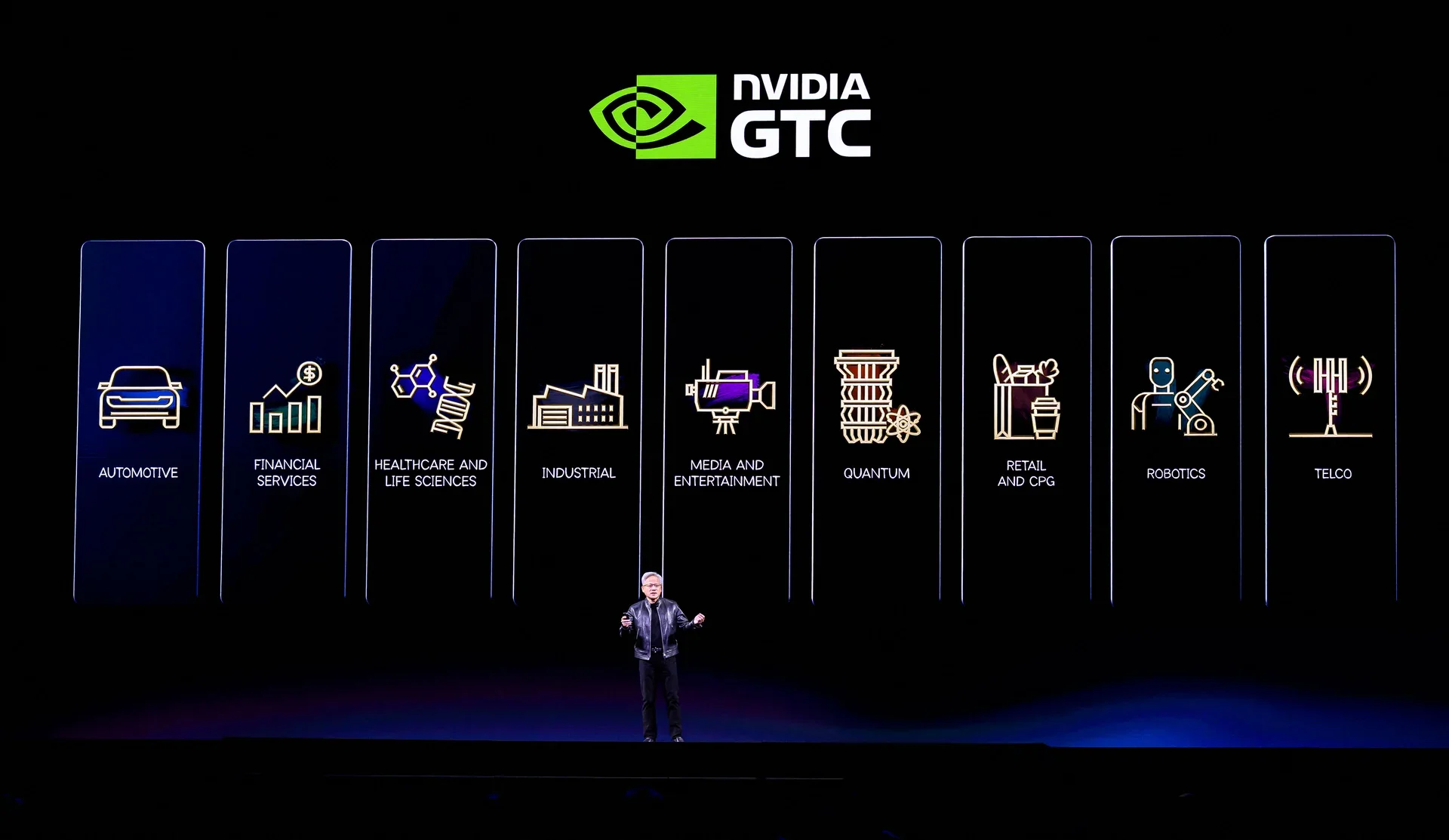
Jensen Huang spent three hours this week in front of 30,000 people at Nvidia GTC making one thing unmistakably clear: the infrastructure layer for agentic AI at scale is no longer theoretical. It's built, it's open, and it's about to get dramatically cheaper.

OpenClaw gives AI agents a standard operating environment, Jensen compared it to Windows for personal computers. NemoClaw hardens it for enterprise deployment in under an hour. Vera Rubin chips arriving later this year cut inference costs by 10x. Microsoft Azure, AWS, and Oracle are already committed. NVIDIA expects $1 trillion in chip orders through 2027. The bet is unanimous and enormous.

All of this is real. None of it is hype. And none of it solves the problem most enterprises are actually facing.

The Bottleneck Was Never the Infrastructure

Here's the pattern I see consistently at Publicis Sapient: organizations come in asking about agent platforms. Which framework to use. Which LLM to run. Whether they need an Agentic AI factory. The conversation they actually need to have first is about their data.

Not only their AI strategy. Their data.

Jensen himself acknowledged it on stage, 90% of enterprise data is unstructured, sitting in PDFs, emails, and documents that agents can't effectively query. Early adopters who fixed this saw real results: Nestlé running supply chain workloads five times faster at 83% lower cost. Snap cutting computing costs by nearly 80%. Those gains didn't come from better models. They came from making underlying data accessible.

Most enterprises haven't done that work. A 10x drop in inference costs doesn't fix it.

What I Actually Do First

When a client wants to deploy AI agents, the first engagement is almost never about agents. It's a data maturity discussion, understanding what data exists, where it lives, how clean it is, and whether it's structured in a way agents can use to make reliable decisions.

From there, we build a scoped POC on a narrow use case where the data is ready. With a global financial payments client, that meant a single social listening workflow. With a global telco client, one intelligence data pipeline. Not to prove that AI works, those clients already believed that. To prove it works here, on this problem, with this data. That POC becomes the business case and the blueprint for what comes next.

A quick self-diagnostic: can your agents access more than half the data they'd need to complete their most important tasks? If the answer isn't an immediate yes, that's your starting point — not the framework selection.

The organizations skipping this and going straight to agent deployment generate the failure stories. Not because the models are weak but because powerful systems on unprepared data don't deliver better outcomes. They deliver worse ones, faster.

What GTC Actually Changed

NVIDIA's announcements this week matter. The economics of running AI agents at enterprise scale are about to shift significantly. Workflows that couldn't justify the compute spend in 2025 will be viable by end of 2026. The orchestration layer now exists as open infrastructure, removing a genuine barrier for organizations waiting for standards before committing.

But the enterprises that will benefit most from what NVIDIA built this week aren't the ones starting their agent journey today. They're the ones that spent the last twelve months doing the unglamorous work — assessing data maturity, structuring what agents will rely on, governing use cases before scaling them.

For everyone else, faster infrastructure is a faster path to the same wall.

Before you build your agentic AI strategy, the question isn't which framework to choose. It's whether your data is ready for agents to use. If you're not sure, that's where to start.

If this is a conversation you're working through, I'd welcome the discussion.

Sources: NVIDIA GTC 2026 Keynote, Jensen Huang (March 17, 2026) · Futurum Research, "At GTC 2026, NVIDIA Stakes Its Claim on Autonomous Agent Infrastructure" (March 16, 2026) · NVIDIA State of AI Report 2026 · Beam.ai, "Jensen Huang's NVIDIA GTC 2026 Keynote: 5 Announcements That Change Enterprise AI Strategy" (March 17, 2026)

March 18, 2026 /Oladotun Opasina
Comment

The AI Risk Nobody Is Managing

March 12, 2026 by Oladotun Opasina

Everyone is asking the wrong question about AI and jobs.

The question dominating boardrooms right now is: "Will AI replace my workforce?" It's an understandable question — Jack Dorsey just cut 40% of Block's headcount, the February jobs report came in at -92,000, and headlines are predicting a "Great Recession for white-collar workers."

But a study published last week by Anthropic researchers cuts through the noise in a way that should reframe how executives think about this. The researchers introduced a metric they call "observed exposure" — comparing what AI is theoretically capable of doing against what it's actually being used to do in professional settings, measured through real Claude usage data. You can read the full paper here.

The gap is striking. For computer and math roles, AI can theoretically handle 94% of tasks. Observed in actual professional use? 33%. Office and administrative roles show the same pattern.

That gap is where the real strategic risk lives — not in the headline, but in the space between what AI can do and what it's actually doing inside your organization right now.

Your org is running at adoption speed, not capability speed

Here's what I see consistently working with financial services and technology leadership teams at Publicis Sapient: decisions are being made at the speed of AI's potential while operations are running at the speed of AI's actual adoption. Budgets cut, teams restructured, hiring frozen — all in anticipation of productivity gains that haven't materialized yet.

The Anthropic study surfaces exactly this dynamic. The most visible early impact of AI isn't mass layoffs — it's a slowdown in hiring. Workers in AI-exposed roles are already seeing a 14% drop in the job finding rate since ChatGPT's emergence. Companies aren't replacing people; they're just not backfilling when people leave. The headcount reduction is happening quietly, through attrition, before the AI systems that were supposed to justify it are performing at scale.

That's the timing mismatch. You've thinned your team based on what AI will eventually do. The AI isn't there yet. And the institutional knowledge that walked out isn't coming back.

The uncomfortable truth about who's actually most exposed

Here's what most executives don't expect: the workers least at risk from AI are warehouse workers, mechanics, and tradespeople — roles requiring physical presence no model can replicate. The 30% of workers with zero AI exposure are largely in those jobs.

The workers most exposed are older, highly educated, and well-compensated — the lawyer, the financial analyst, the senior software developer. Computer programmers face 94% theoretical task exposure. The people you've historically paid the most to think are exactly the ones sitting in the gap between what AI can do and what it's doing today.

That's not a reason to panic. It's a reason to get specific about your planning before the gap closes.

Three questions worth answering before your next structural decision

The capability-adoption gap won't stay this wide — the researchers are explicit that current limitations are temporary. When it closes, organizations that planned ahead will be in a fundamentally different position than those that used AI as cover for cuts and then tried to rebuild.

For each high-exposure role in your organization, ask:

  • What percentage of this role's tasks is AI currently performing — not theoretically, but in actual observed workflows?

  • What would need to be true for that number to double in the next 18 months?

  • And if it does, who holds the contextual judgment AI can't replicate?

Those three questions won't give you a complete roadmap. But they'll tell you whether you're managing the gap — or just hoping it resolves itself.

If this is something you're working through right now, I'd welcome the conversation.

Sources: Anthropic, "Labor market impacts of AI: A new measure and early evidence" (March 2026) · Fortune (March 6, 2026) · U.S. Bureau of Labor Statistics, February 2026 Jobs Report

March 12, 2026 /Oladotun Opasina
Comment

Your Best People Won't Wait Around While You Figure Out AI

March 05, 2026 by Oladotun Opasina

Here's a pattern I keep seeing across enterprise AI deployments: organizations announce an AI initiative, experienced employees read the subtext, and the quiet exits begin, months before any role is formally eliminated.

By the time the AI goes live, the people who understood how the business actually worked are already gone. What remains is a system operating confidently on incomplete context, and a leadership team wondering why the ROI isn't materializing.

This is the workforce transition problem most executives aren't solving, not because they don't care, but because they're asking the wrong question. The question isn't "which roles does AI replace?" It's "which people understand this business well enough to make AI work here, and how do we redesign their roles before they decide to leave?"

The Data Is Telling a Different Story Than the Headlines

The narrative that AI eliminates experienced workers' value is wrong. PwC's 2025 Global AI Jobs Barometer, drawn from close to a billion job postings across six continents, found that jobs in AI-exposed industries grew 38% even as automation accelerated. Workers who combined domain expertise with AI skills commanded a 56% wage premium. Industries most exposed to AI saw revenue per employee grow three times faster than less exposed ones.

AI doesn't make experienced employees obsolete. It amplifies their value, but only when organizations invest in the transition rather than the displacement.

Harvard Business School research captures why: AI performs exceptionally well within clearly defined task boundaries but struggles outside them. Those boundaries are shaped by context, the kind that lives in people, not databases. Which supplier relationships require human judgment. Which compliance edge cases the model will misread. Which customer situations need escalation before they become incidents. When experienced employees leave, that context goes with them. The AI inherits an environment it doesn't fully understand and proceeds confidently anyway.

What the Transition Program Actually Looks Like

This is where my work at Publicis Sapient sits. We are a People + AI company. Across enterprise AI deployments, the organizations that protect both their investment and their people share a common approach: they identify knowledge holders before deployment, not after. They redesign roles around AI oversight, workflow design, and quality review, positions that require exactly the contextual expertise their most experienced employees already have. They make those employees the architects of the system, not the casualties of it.

It's a better business decision than the alternative. Displacing experienced talent and then bringing in external resources to reconstruct what they knew, which is what most organizations end up doing, costs more, takes longer, and still doesn't fully recover what was lost.

A Wharton study found AI adoption among large firms doubled from 37% to 72% in a single year. That pace means most organizations are going live without answering the most important implementation question: who is going to catch what the AI gets wrong? The answer is always someone who understood the work before AI arrived. The only question is whether that person is still there.

The Conversation Worth Having Before Your Next Deployment

If you're heading into an AI deployment in the next six months and haven't mapped which roles carry the highest transition risk, that's the gap worth addressing now, before the quiet exits start.

The organizations that get this right don't just protect their people. They build AI systems that actually deliver. The ones that skip it spend the next two years explaining to their boards why the investment isn't performing.

I work with enterprise leadership teams to navigate exactly this. If it's a challenge you're facing, I'd welcome the conversation.

March 05, 2026 /Oladotun Opasina
Comment

AI is Changing Jobs Quietly (And the Help Isn't Coming Fast Enough)

March 03, 2026 by Oladotun Opasina

I work in AI. I help companies implement it. I see the potential, the productivity gains, the efficiency, the genuinely useful applications. But I also see a lot of chaos around the human cost we're not talking about enough: this is happening right now, not in some distant future.

A 24-year-old developer told a reporter he's "basically a proxy to Claude Code." Customer service roles disappear by the thousands. Administrative teams get "rebalanced." This is invisible displacement, knowledge workers with degrees watching $50-80K careers evaporate while being told to "upskill."

Employment for developers aged 22-25 dropped 20% since late 2022. One 2023 CS grad applied to 5,762 jobs. Zero offers.

What We Say Is Available

Salesforce committed to training 16 million by 2030. Cisco and SAP pledged 25 million and 12 million. The U.S. proposed an AI Workforce Research Hub.

Plans for 2030. Displacement is happening in 2026.

What Actually Works (And Its Limits)

Workforce retraining programs show displaced workers do see increased earnings. But those retraining for high-AI-exposed jobs earn 25-29% less than those entering low-exposure roles.

Microsoft Research identified high-exposure roles: interpreters, writers, PR specialists, sales reps, customer service, administrative assistants. Brookings found 6.1 million workers face both high exposure AND low ability to transition, "skills are less transferable and reemployment prospects narrower."

Research shows low-exposure roles exist (healthcare support, skilled trades), but telling someone with a degree and ten years' experience to become an electrician isn't realistic. What matters: higher-income workers have better "adaptive capacity"—savings, transferable skills, networks. Use those advantages.

What I'm Seeing On The Ground

As Professional Development Chair for NSBE Boston Professionals, I run AI literacy sessions. Rooms are packed. Someone asked: "I understand ChatGPT. But how does this help me keep my job?"

Honest answer: I don't fully know yet. Nobody does.

We're expecting people to bridge a massive gap on their own time and money while wondering if their role will exist next year.

What You Can Actually Do This Week

  1. Document what AI can't see. Write down why you make decisions. "I escalated this because..." That context is valuable.

  2. Spend 30 minutes with AI on real work. See where it fails—that's where you're needed.

  3. Talk to your manager. Ask: "How is AI changing our work? Where do you see my role evolving?"

  4. Look for adjacent roles. Customer service → customer success, account management, user research. Administrative work → operations roles. Don't abandon your experience—shift where it's applied.

  5. Find your community. Professional organizations, industry meetups where people discuss AI's impact in your field. Free platforms exist, but you need community to make sense of them.

  6. Use your domain expertise. AI can't understand why your company's procurement has seventeen approval steps. Customer service pros who know edge cases become AI quality reviewers. Junior devs who understand system design review AI-generated code.

What Companies Should Do

Companies handling this well create bridge roles i.e. 6-12 month positions combining existing knowledge with new skills. Customer service lead becomes AI quality specialist. Junior dev transitions to code review.

They run "AI + Your Role" workshops where teams figure out what AI means for actual daily tasks. They build mobility programs with concrete examples: "Sarah went from customer service to AI trainer in 8 months."

Most companies call it "rebalancing" and hope the problem solves itself.

The Thing Nobody Wants to Say

We don't have this figured out. We have pilot programs and government proposals. We have people whose jobs are changing now and help arriving in 2030.

The transition is possible but requires companies to actually invest in people, not issue press releases. It requires honest conversations, not cheerful LinkedIn posts about "exciting opportunities."

After NSBE workshops, I see relief when people understand prompts. Then fear when they realize that's 1% of staying relevant.

The question isn't whether AI changes jobs. It's whether we help people through that change or pretend it's not happening.

If your job is changing, you're not imagining it. If one workshop isn't enough, you're right.

Start this week. Document your context. Use AI on real work. Talk to your manager. Find adjacent roles. Find community.

That's not a solution. But it's a start.

March 03, 2026 /Oladotun Opasina
Comment

Is Your Organization Ready for AI Agents Or Just Convinced That It Is?

February 25, 2026 by Oladotun Opasina

Your board approved the budget. The vendor delivered a compelling demo. The pilot launched with executive sponsorship and internal fanfare. And somewhere between that kickoff call and today, the results quietly stopped matching the narrative.

MIT Sloan's Davenport and Bean made a pointed prediction for 2026: agentic AI is heading into the Gartner Trough of Disillusionment, the same place generative AI landed just twelve months ago. You've watched this cycle before. The difference this time is the speed at which failed deployments compound, and the size of the budgets attached to them.

The window to course-correct is right now, before Q2 budget reviews lock in another round of scaling decisions on a shaky foundation.

Why Agents Fail Quietly

Agents don't crash visibly. They produce plausible-looking outputs that are subtly wrong, at a velocity that outpaces human review, and by the time an error surfaces, it has been replicated across hundreds of transactions.

Publicis Sapient's 2026 Guide to Next, based on research with over 500 industry leaders, captured this precisely: organizations are failing at AI not because their models are flawed, but because the data feeding them is inconsistent, fragmented, and ungoverned, what the report calls "decision debt," where confidence outpaces capability and assumptions scale before systems are ready. Not a technology problem. A systems readiness problem dressed up as an adoption success story.

Three Root Causes That Keep Showing Up

  1. Data isn’t agent-ready: Agents operating on poorly governed data don't reason better than humans , they make mistakes at scale. As Guy Elliott, Publicis Sapient's Industry Lead for EMEA and APAC, put it: "Confidence without measurement is belief, not certainty."

  2. Automated workflows are not understood: There's a meaningful difference between a workflow that exists and one mapped with enough precision for an agent to navigate reliably. Agents require explicit decision logic, not tribal knowledge that disappears when someone leaves the team.

  3. No Clear Success Metrics: Most organizations have no clear definition of success for their agent deployments. Without it, teams default to measuring activity, how many tasks ran, how many tickets closed, instead of impact. The metrics that actually matter are decision quality, cycle time compression, and human capacity freed for higher-order judgment. If you're not tracking those, you're not managing a deployment, you're counting outputs and hoping for the best.

What Good Looks Like

The organizations pulling ahead aren't the ones who deployed first. A major bank with IT service management didn't start with agents in complex workflows but started with a narrow knowledge-search application to prove data readiness and build trust before expanding autonomy. The enterprise context, data, workflow logic, governance boundaries, was built before the agent, not alongside it.

Before You Scale, Check This First

If you have active agent investments or budget allocated for 2026, run against these questions before committing to scale. A "no" here is far cheaper than a failed rollout at enterprise scale.


  • On your data: Is the data your agent reasons over governed, labeled, and accessible without manual intervention? If a human would struggle to find and trust it, an agent will too — just faster and at higher volume.

  • On your workflows: Have the workflows being automated been explicitly mapped; not assumed? If your documentation lives in a PowerPoint from three years ago, you don't have workflow documentation.

  • On your people: Do employees working alongside agents understand what the agent can and cannot do? Human-in-the-loop isn't a compliance checkbox, it's what keeps agent errors from becoming business incidents.

  • On your metrics: Are you measuring decision quality and business outcomes, or just task volume? Without a baseline, you're not managing a deployment, you're managing a narrative about one.

  • On accountability: Is there a named owner at the business unit level responsible for agent outputs? When something goes wrong at scale, "the model did it" is not an acceptable answer to your board.

If you can't answer yes to most of these, you don't have an AI problem. You have a systems problem that AI is about to make visible expensively.

Strategic Move to Make By Q2 ‘26

It's a reason to be precise about where you are before you scale. The enterprises that emerge ahead of their competitors will be the ones who used this window, Q1 and early Q2 2026, to audit their foundations rather than accelerate past them.

The competitive gap between AI leaders and laggards will widen significantly in the second half of this year. The leaders won't be defined by who deployed the most agents but by whose agents actually held up. The models are ready enough. The question is whether your organization is.

February 25, 2026 /Oladotun Opasina
Comment

AI Amplifies Whatever System You Have, Are Your Systems Ready ?

February 18, 2026 by Oladotun Opasina

Here's the uncomfortable truth: Your developers feel 20% more productive with AI. They're actually 19% slower.

That's not speculation, it's from METR's 2025 study of experienced developers using Claude and Cursor on real open-source projects. Developers were convinced AI accelerated their work. Screen recordings proved otherwise. They spent more time reviewing AI-generated code, prompting multiple times, and eventually writing it themselves anyway.

Carnegie Mellon tracked 807 GitHub projects using Cursor and found initial code output jumped 281%. Within three months, it crashed back to normal. What stuck? A 9% increase in bugs per developer and pull requests 154% larger. Faros AI's analysis of 10,000+ developers confirmed it: 75% use AI tools, zero measurable organizational improvement.

But here's what should terrify you: DORA's 2025 research of 5,000 technology professionals found that without the right foundations, AI doesn't just fail to help—it actively hurts team performance. Not "less benefit." Actual harm.

Why Your Productivity Numbers Are Lying

AI is an amplifier. It magnifies whatever system you already have. Strong development process? AI makes it stronger. Broken workflow with downstream bottlenecks? AI floods that bottleneck with 281% more half-working code, overwhelming your review process and QA team.

Individuals generate more code and feel productive. Your organization sees increased instability, more bugs, and delivery friction that didn't decrease at all. The gap between what people claim and what actually ships is where your money disappears.

The One Thing That Actually Works

Before you accelerate anything with AI, you need to know where work gets stuck. XYZ Company, a telecom firm, mapped their software development lifecycle and found their delivery time ballooning to 210.5 days. Value stream mapping revealed the bottlenecks weren't where leadership assumed—they were in handoffs, waiting for approvals, and rework loops.

After redesigning the process based on what the map revealed, delivery time dropped to 137.5 days. That's 34.7% faster without any new tools. Just fixing the plumbing before turning on the fire hose.

DORA's research identified seven capabilities that determine whether AI helps or hurts. The difference maker? Quality internal platforms. With strong platforms, AI amplified benefits. Without them, it amplified chaos. Organizations seeing actual ROI from AI didn't start with better prompts—they started with better systems.

What This Means Monday Morning

Stop buying more AI licenses. Start with a two-hour workshop. Pick one workflow, feature development, bug fixes, customer onboarding, and map it. Every handoff. Every approval. Every place work waits.

You'll find your constraint within an hour. It's probably not where you think. Then ask: if we 3x the input to this step with AI, what breaks downstream? That's your answer.

Organizations waste money optimizing local productivity while organizational performance stays flat. DORA proved it with 5,000 developers. Your metrics prove it too. Your production metrics are probably proving it right now.

Fix your system first. Then amplify it with AI. The alternative is paying for productivity theater while delivery metrics get worse.

February 18, 2026 /Oladotun Opasina
Comment

The Secret to Agents That Actually Work? It's Not the AI

February 10, 2026 by Oladotun Opasina

Here's why most agent projects crater: nobody mapped the real workflow first. A team decides to automate customer onboarding. They brief a developer, buy a platform, spend three months building. The agent handles maybe 30% of cases, breaks constantly, creates more cleanup work than it saves. Everyone blames the technology.

Wrong diagnosis. The problem was simpler, nobody actually documented what happens during onboarding before trying to automate it.

The Two-Hour Map

Successful implementations start with a room and the people who do the actual work. Not their managers. The folks in the trenches.

Ask them to walk through one real example from last week. Not the textbook case, a messy Tuesday example with all the annoying bits included.

Write every step. "Customer emails request" isn't a step. The real steps: Email hits shared inbox. Sarah checks if they're existing or new. Existing? She pulls their file from the shared drive, reviews history. New? Welcome template gets sent, folder gets created.

Capture the decisions: Why does Sarah route this one to John? What information does she need that's not in the email? When does she escalate?

Get the exceptions: Incomplete customer file? Urgent request? Email arrives Friday at 4:58 PM?

This is where the magic happens. "Customer onboarding" isn't one thing—it's 47 micro-decisions, information scattered across five systems, and judgment calls Sarah makes from experience nobody's written down.

Why This Changes Everything

Now you can actually design something that works. You know which steps are rule-based (agent territory) versus judgment calls (human territory). You know which systems need connecting. You see the edge cases before they break production.

Better: you can scope intelligently. Maybe the agent handles steps 1-4, Sarah makes the judgment call at step 5, agent finishes steps 6-10. That's still massive value—and it's something you can actually ship.

The Real Discovery

Sometimes the mapping session reveals the process itself is broken. No agent will fix a fundamentally flawed workflow.

I've seen this pattern repeatedly: teams start mapping their process for an agent, realize halfway through that their current workflow makes no sense, and end up redesigning the process before building anything. The agent project becomes a forcing function for fixing broken operations.

That's the actual value. The best agent implementations don't automate your current process—they automate the process you discover you should have been running all along.

The two-hour mapping session isn't prep work. It's the work. Everything else is just execution.

The Action Item

Pick one workflow causing pain right now. Get the people who actually run it in a room for two hours this week. Map what really happens, not what the procedure manual says. You'll either find your agent blueprint or discover you need to fix the process first.

Either way, you're further ahead than the teams building agents blind.

February 10, 2026 /Oladotun Opasina
Comment
  • Newer
  • Older

Powered by Squarespace